National Context
 The career pathways approach has emerged as a national strategy for helping both job seekers and incumbent workers keep pace with evolving labor market demands. At its core, the model is a structured sequence of education, training, and work‑based learning opportunities that lead to progressively higher levels of skill, responsibility, and wages.
What distinguishes career pathways from more traditional approaches is its emphasis on alignment:
- between training and labor market demand
- across education and workforce systems
- between the needs of individuals and businesses
This approach is grounded in a dual‑customer model, intentionally designed to meet the needs of both people with disabilities and employers:
- People with disabilities gain access to training, credentials, and career opportunities that support long‑term advancement
- Businesses benefit from a more reliable pipeline of skilled workers prepared to meet current and future workforce needs
Across the country, labor market trends continue to show growth in key industries, many of which offer clear career ladders and advancement opportunities. At the same time, employers consistently report difficulty finding candidates with the skills and credentials needed to fill these roles.
This creates a critical opportunity for VR agencies to play a more strategic role. By aligning services with high‑demand sectors and supporting access to industry‑recognized training, VR can help build a pipeline of qualified candidates while ensuring people with disabilities are positioned to succeed in competitive, high‑quality careers.
Recognizing this opportunity, the Rehabilitation Services Administration (RSA) has invested in career pathways as a priority strategy. Since 2015, RSA has funded a series of Disability Innovation Fund (DIF) model demonstration projects to identify, test, and refine approaches that support career advancement for people with disabilities. These investments are focused on developing replicable models and strengthening the evidence base for career pathways within VR.
Strengthening the Evidence Base: Evaluation Methods and Measures
A central goal of the RSA Disability Innovation Fund (DIF) Career Pathways projects has been not only to implement new approaches, but to build a stronger evidence base for what works in advancing individuals with disabilities in the workforce. To support this, projects have incorporated comprehensive evaluation strategies that expand beyond traditional VR performance measurement.
At a foundational level, these projects align with the Workforce Innovation and Opportunity Act (WIOA) indicators of performance, which focus on outcomes such as employment rates, median earnings, credential attainment, and measurable skill gains. These indicators emphasize the quality of outcomes, including whether individuals obtain competitive employment, earn sustainable wages, and make progress in education and training.
At the same time, DIF projects build on this framework by introducing additional measures that reflect the long‑term nature of career advancement.
In addition to traditional metrics, evaluation approaches track how people move along a career pathway over time, including:
- Entry into targeted industries or sectors
- Participation in education and training
- Attainment of industry‑recognized credentials
- Progression into competitive integrated employment
- Increases in wages, hours, and access to employer‑provided benefits
These measures reflect a more longitudinal view of success, recognizing that career development is an ongoing process rather than a single outcome at case closure.
To better capture this progression, DIF projects often incorporate expanded performance indicators, such as:
- Number of career pathways accessed or developed
- Employment outcomes at multiple time points (e.g., 90 days, quarterly follow‑up)
- Wage progression over time rather than a single reporting period
- Continued credential attainment and skill development
This approach allows for more meaningful comparisons across WIOA core partners while providing a more complete picture of participant outcomes.
Beyond performance metrics, evaluation efforts rely on a combination of quantitative and qualitative methods to understand both outcomes and implementation.
Quantitative data can help identify patterns in employment, retention, and advancement. Quantitative sources include:
- case management systems
- wage records
- credential tracking
At the same time, qualitative data provide important context, helping to explain how and why outcomes are achieved. Qualitative sources include:
- participant interviews
- staff feedback
- employer input
- case studies documenting individual career journeys
Together, these methods offer a more comprehensive understanding of what is working, for whom, and under what conditions.
Many projects also use developmental and formative evaluation approaches, recognizing that career pathways models are implemented and refined over time. Rather than relying solely on end‑of‑project evaluation, these approaches provide ongoing feedback that allows agencies to adjust strategies, strengthen partnerships, and better align services with labor market demand.
Cross‑system data alignment is another important component. By coordinating data across VR, workforce, and education systems, agencies can more effectively track outcomes over time and better understand how individuals move across programs and services. This supports stronger integration within the broader workforce system and enhances the ability to measure long‑term impact.
Demonstration Projects and Program Design

Rehabilitation Services Administration
Disability Innovation Fund – Career Advancement Initiative Model Demonstration Project
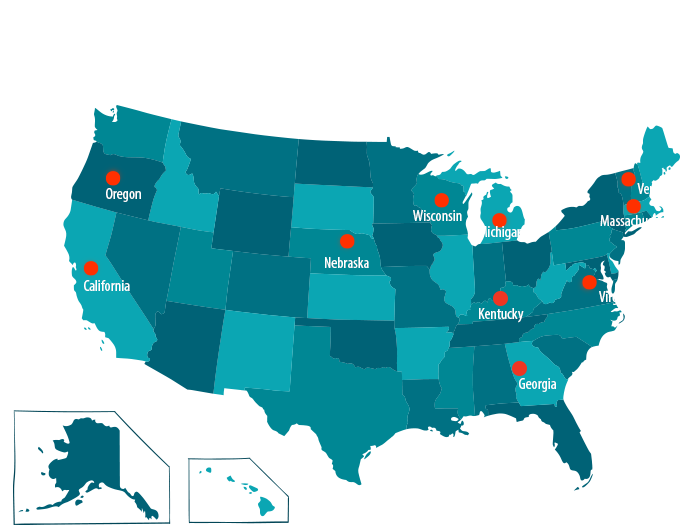
The growing investment in career pathways has resulted in a diverse set of model demonstration projects across state VR agencies. Ten state VR agencies, including Nebraska, Virginia, Kentucky, Georgia, Oregon, Vermont, Michigan, Wisconsin, Massachusetts, and California, have implemented career pathways models tailored to their unique contexts.
While approaches vary, these initiatives share a common goal: to build systems and partnerships that enable people with disabilities to gain marketable skills, earn credentials, and advance in high‑demand careers.
Participants may enter at different points along a pathway, but the overall progression is consistent, moving toward competitive integrated employment with sustainable wages and opportunities for advancement.
Across projects, common program elements include:
- entry into a career pathway within a targeted industry
- engagement in education, training, or work‑based learning
- attainment of industry‑recognized credentials
- transition into competitive integrated employment
- continued advancement through increased wages and benefits
State Demonstration Examples
Several states illustrate how career pathways can be translated into practice through different, but complementary, approaches. While each model reflects local priorities and partnerships, they all demonstrate how career pathways can be operationalized within VR systems to support long‑term advancement.
 Nebraska – Career Pathways Advancement Project (CPAP)
Nebraska was one of the first VR agencies in the country to implement the upskill/backfill model, positioning it as a core strategy to promote economic self‑sufficiency for people with disabilities. This approach focuses on helping individuals move from entry‑level, often low‑wage jobs into stable, higher‑paying positions with benefits. As individuals advance, their previous roles are backfilled, creating new opportunities for other VR participants.
The model has been recognized as a best practice by the National Governors Association Center for Best Practices. CPAP was intentionally designed to align with WIOA performance measures, particularly those related to wages, credential attainment, and measurable skill gains. Beyond individual outcomes, the model also strengthens employer partnerships by addressing workforce needs through advancement and talent pipeline development.
 Oregon – Inclusive Career Advancement Program (ICAP)
Oregon’s ICAP model emphasizes cross‑system collaboration as the foundation for career advancement.
ICAP brings together VR, community colleges, workforce agencies, and community‑based organizations to create an integrated system of support. A defining feature of the model is the use of clearly established referral pathways that allow people to move between systems with greater ease. Participants may enter through VR or be identified through college‑based career coaches who can connect them back to VR services when needed.
One ICAP participant, Amber, talks about her experience working with her VR counselor to go back to pursue her education and eventually get a job in medical billing in a supportive environment that has really helped her build self-esteem and expand on her goals for the future.
Learn more about the ICAP implementation framework.
Learn more about Nebraska CPAP’s success stories:
Sara Stewart was a mechanic in the US Army but was discharged when she hurt her back. She could not continue doing work as a mechanic and identified being a CDL driver as her new goal. CPAP assisted her in getting her CDL license along with several other certifications. Watch Sara’s Video or listen to the podcast.
Todd’s BBI International, Inc. worked with the CPAP team in Nebraska to help some of their employees advance in the company. David Kelley had secured a job there originally with Nebraska’s VR help and got the training he needed to be able to advance to plant manager. VR was able to backfill all the vacancies created through the upskill with other VR job seekers. Watch David’s Video or listen to the podcast.
Chris Olsen was working in information technology but did not have the required degrees to advance. After completing the necessary credentials, Chris was able to secure a job in information systems management with a new company. Watch Chris’s Video.
Learn more about CPAP 2.0.
 Vermont – Vermont Career Advancement Project (VCAP)
Vermont’s model centers on “earn and learn” strategies, including pre‑apprenticeships, apprenticeships, and credential‑based training aligned with high‑quality career pathways. A key strength of VCAP is its recognition that career advancement is rarely linear.
The program is intentionally designed with flexible entry and exit points, acknowledging that individuals may pause and re‑engage due to life circumstances. This perspective helps create more realistic expectations for both participants and program implementation. VCAP also invested in additional staff capacity, rather than redistributing existing staff responsibilities, to ensure focused support for participants.
Another distinguishing feature is the use of progressive education, which emphasizes a series of activities that build skills and readiness over time. These include career assessments, informational interviews, campus or worksite tours, short‑term training, and apprenticeship opportunities. This approach aligns closely with the principle that “everyone is ready for something,” allowing individuals to engage at a level appropriate to their current readiness while continuing to build toward long‑term goals.
In 2024, Mathematica published a brief highlighting that several VCAP participants reached important program milestones, including earning wages approximately 65 %higher than Vermont’s minimum wage.
Learn more about VCAP.
Progressive Education – Grade Levels
Activities and experiences aligned to each grade level
| Activity / Experience | Grade 7 | Grade 8 | Grade 9 | Grade 10 | Grade 11 | Grade 12 | Post High School |
|---|---|---|---|---|---|---|---|
| Career Guest Speaker | — | — | — | ||||
| Career Fair | — | — | — | ||||
| Career Assessment | — | — | |||||
| Informational Interview | — | — | — | ||||
| College Campus Tour | — | — | — | — | |||
| Course Audit or Workshop | — | — | — | — | |||
| Dual Enrollment in College Courses | — | — | — | — | |||
| CTE Program Enrollment | — | — | — | — | |||
| Early College | — | — | — | — | — | — | |
| Transition Support Programs | — | — | — | — | — | ||
| Related Instruction for Apprenticeship | — | — | — | — | — | — | |
| Post-Secondary Program Enrollment | — | — | — | — | — | — |
 Massachusetts – NextGen Careers
Massachusetts’ NextGen model focuses on expanding access to career pathways for people who have traditionally been underserved by VR, particularly young adults with disabilities. The program combines cohort‑based training, career exploration, and integrated resource teams to provide coordinated, participant‑centered support.
Participants engage in structured activities such as Career Exploration Academies and group training cohorts aligned with specific industries, including healthcare, manufacturing, and information technology. The program also emphasizes work‑based learning through internships and job‑driven training experiences, particularly for people with limited prior work experience.
A central feature of NextGen is its focus on self‑determination, including the development of self‑capacity, self‑advocacy, self‑realization, and self‑sufficiency. By integrating these foundational skills with technical training and career exploration, the model supports both employment outcomes and long‑term personal and professional growth.
The following video follows Ernesto’s journey as he connects with his NextGen counselor to explore his interest in the tech industries and find a career path that is close to his interests.
Learn more about the NextGen program.
 California – Pathways to Success
California’s Pathways to Success model demonstrates how coordinated partnerships and work‑based learning can create meaningful career pathways for people with disabilities. The program connects the Department of Rehabilitation with community colleges, employers, and workforce partners to provide structured opportunities aligned with high‑demand industries.
A key component of the model is its emphasis on experiential learning, including internships, apprenticeships, and job‑driven training. Participants receive individualized support, including financial assistance, mentorship, and accessibility services, to help navigate both educational and workplace environments.
The model highlights how strong collaboration with employers and education systems can result in more direct pathways from training to employment. By aligning academic programs with workforce needs and providing real‑world experience, participants are better prepared to enter and advance within their chosen fields.
Learn more about Pathways to Success.
Connecting Across Models
While each state model varies in design, several common patterns emerge across these examples:
- Intentional integration across systems to support seamless transitions
- Flexible pathways that accommodate individual readiness and life circumstances
- Strong emphasis on work‑based learning and credential attainment
- Deep employer engagement to align training with workforce needs
- A focus on advancement over time, rather than one‑time placement
Taken together, these examples illustrate how career pathways can be adapted to different contexts while maintaining a consistent focus on long‑term career growth and economic mobility.
Emerging Themes Across Demonstration Projects
Across these efforts, several consistent themes are shaping what effective career pathways implementation looks like within VR:
- Strong business engagement, with employers actively shaping training and advancement opportunities
- Sector‑based strategies focused on high‑growth industries
- Use of stackable credentials and work‑based learning
- Flexible pathways that support varied entry points and individualized pacing
- Cross‑system collaboration across VR, education, and workforce partners
Outcomes and Early Evidence
As these models mature, early findings show promising results:
- Participants are earning credentials, completing training programs, and entering competitive integrated employment with wages that exceed minimum wage levels.
- Many are working full‑time and benefiting from improved job quality and stability.
These outcomes suggest that career pathways approaches can support quality employment with clear opportunities for advancement. Participant experiences also highlight the importance of sustained, individualized support throughout the process.
Bringing Research into Practice
Taken together, these demonstration projects represent an important step toward establishing career pathways as an evidence‑based practice within VR. While implementation approaches vary, the core principles remain consistent:
- alignment with labor market demand
- strong partnerships
- a focus on long‑term career advancement
These efforts demonstrate that Career Pathways is not a single program, but a flexible framework that can be adapted across settings. As the evidence base continues to grow, these models provide both validation and practical guidance for agencies seeking to strengthen outcomes and expand their impact.
Additional Materials
- Virginia Career Pathways webinar series (George Washington University)
- The Vermont Career Advancement Project: A Way for Vermonters with Disabilities to Find Meaningful High-Wage Work
- Participants’ Characteristics and Experiences from the First Two Years of the Vermont Career Advancement Project
- Technical Assistance Center for Quality Employment: VR Career Pathways Toolkit