The Value of Work
What happens when people with intellectual disabilities (ID) are employed in competitive, integrated settings? Usually, their life gets significantly better.
Research shows there is well-established relationship between competitive, integrated employment and increased quality of life, self-determination, personal independence, and reduced support needs. And through the process of getting and keeping a job, people with ID often find meaning, community, purpose, increased financial stability, and continuous opportunities to grow and learn 1.



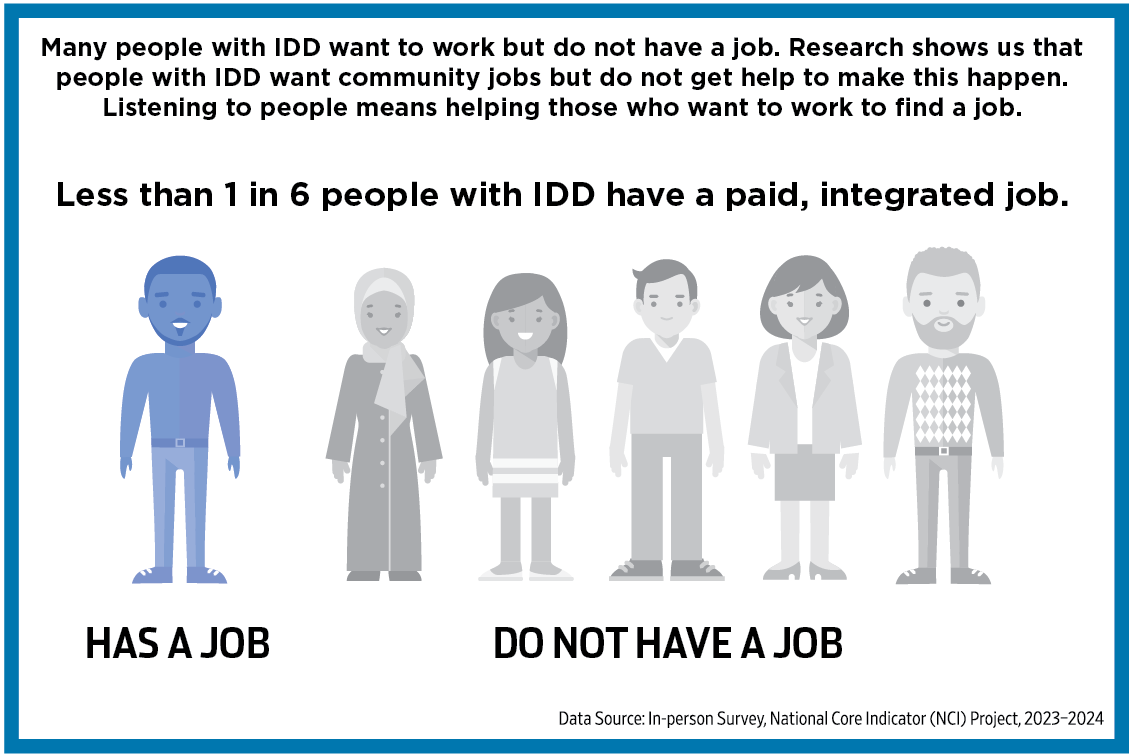
People with ID want to work.
People with ID want to work in jobs that match their interests. They want to earn money, be active in their communities, and learn new skills 2. Students and their family members have high expectations for employment. State Employment First policies have helped increase the demand for services that lead to competitive employment opportunities.
People with ID face barriers to employment.
People with ID experience an array of needs that present barriers to employment:
- Cognitive challenges can impact their ability to understand and retain new information, communicate, and live and work independently.
- They may perceive sensory input in complex ways and express their thoughts and feelings differently.
- They face stigma and low expectations for successful employment.
- Traditional pathways toward educational, vocational, and community-life goals do not meet their needs.
- Systems designed to help them are difficult to navigate.
These factors compound existing barriers over time and increase risk for social, psychological, and economic challenges.
What is the role of vocational rehabilitation (VR)?
The data suggest that most VR counselors do not have the experience or training needed to effectively address the needs of this people with IDD.
Even as the demand for services grows, people with IDD make up just 9% of the total national VR caseload. Most people with IDD do not exit VR with a job within 1 year of applying for VR services 3 .
But VR services are critical.
People with IDD are more than twice as likely to get a job in the community if they receive services from VR compared to those who don't 4. Job seekers with ID need VR counselors who can use their expertise to get involved early, develop trust, and leverage evidence-based strategies to make competitive, integrated employment possible.
What will you find in the toolkit?
This toolkit is designed to equip VR staff and their partners to meet these needs. Practical articles, videos, and engaging online modules teach strategies and tips for:
- providing accessible and inclusive services that enhance participation and build rapport with job seekers
- tailoring career planning services to meet individual needs
- engaging early and effectively with youth
- navigating individual and family dynamics with empathy and understanding
- encouraging the development of self-determination skills
- using technology to support competitive employment
A Note About Language: While the IT’S EMPLOYMENT project focused on VR services for people with intellectual disabilities (ID), research, data reporting, and state systems often have a broader focus on people with intellectual disabilities and developmental disabilities (IDD). In this toolkit, you will see references to both ID and IDD to be consistent with the nature of the research, knowledge, and resources.
This toolkit is a product of the IT’S EMPLOYMENT Innovative Training Grant funded by the Rehabilitation Services Administration (H263C190011). The contents do not necessarily represent the policy of the Department of Education, and endorsement by the Federal Government should not be assumed.
Toolkit materials are designed to support vocational rehabilitation staff and related partners in improving employment services and outcomes for people with intellectual disabilities who receive services through vocational rehabilitation agencies.

Sources
[1] Gilson, C. B., Sinclair, J., Whirley, M. L., Li, Y.-F., & Blustein, D. L. (2022). “More than a Job, it’s a Purpose”: A Psychology of Working Perspective of the Working Experiences for Individuals with Intellectual and Developmental Disabilities. Journal of Career Assessment, 30(2), 367–386. https://doi.org/10.1177/10690727211048898
[2] Hennessey, R. E., & Goreczny, A. J. (2022). Employment preferences of individuals with intellectual and developmental disabilities: An evaluation of gender and age differences. Journal of Applied Research in Intellectual Disabilities, 35(3), 878–888. https://doi.org/10.1111/jar.12992
[3] Winsor, J., Timmons, J., Butterworth, J., Migliore, A., Domlin, D.,, Zalewske, A., and Shepard, J. (2018). StateData: The national report on employment services and outcomes 2016. https://www.thinkwork.org/sites/statedata.info/files/files/statedata_bluebook_narrative_2016.pdf
[4] Nord D. (2016). More Job Services-Better Employment Outcomes: Increasing Job Attainment for People With IDD. Intellectual and developmental disabilities, 54(6), 402–411. https://doi.org/10.1352/1934-9556-54.6.402