What is the Rapid Engagement Team Approach (RETA)?
RETA advances employment for job seekers with disabilities who receive Social Security Disability Insurance (SSDI).
How does RETA advance employment?
The RETA model has been shown to improve employment and wage outcomes for SSDI beneficiaries by reducing delays and providing a team approach that involves early and ongoing benefits counseling and job placement support.
Why RETA?
A randomized control trial and follow-up study found VR customers who received services through the RETA model were more likely to:
- have a signed Individualized Plan for Employment (IPE) within 30 days of applying for VR services
- get competitive integrated jobs
- earn at or above Substantial Gainful Activity (SGA) level
An in-depth qualitative study found that the RETA model helped SSDI beneficiaries make informed decisions about their paths forward with less anxiety about losing benefits.
At the Institute for Community Inclusion (ICI), we partner with VR agencies to implement the RETA model.
View the RETA informational webinar and download the presentation slides [PDF].
The RETA Model
The RETA model was created to help SSDI beneficiaries get better jobs and earn higher wages when they work with VR.
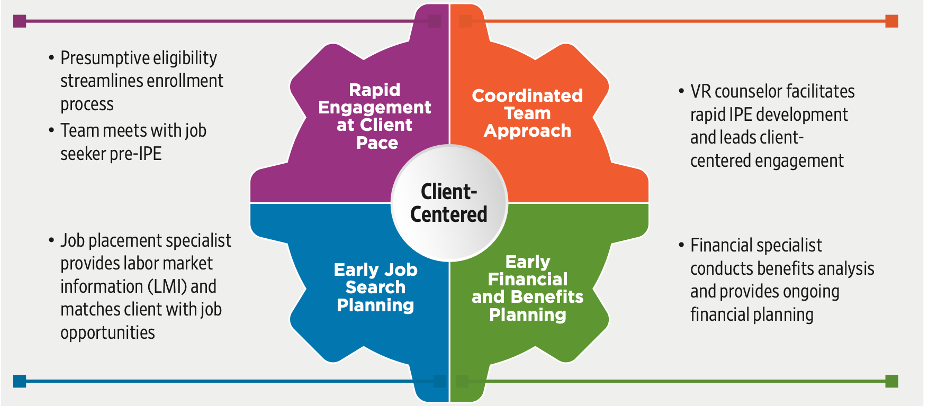
Four main RETA model components include:
- Rapid engagement at the client’s pace
- Adopt of presumptive eligibility strategies
- Reduce bureaucratic procedures, like paperwork
- Align the client’s performance and case file review with rapid engagement performance goals
- Coordinated team approach:
- Develop a job seeker-specific coordinated team that includes, at minimum, a counselor, an employment specialist, and a financial work incentives specialist
- Early financial and benefits planning:
- Introduce the job seeker to the team directly for pre-IPE discussions
- Early job search planning:
- Support the job seeker and the job placement specialist to find job opportunities in the local economy before IPE
The RETA Project
Goals
Activities
The RETA project embeds the lived experiences of SSDI beneficiaries into all activities and resources. ICI researchers will draw on past studies and conduct interviews and focus groups with VR customers to gather their perspectives and experiences, which will inform project activities and provide key insights to VR agencies on model implementation.
RETA Learning Collaborative
The RETA Learning Collaborative brings VR practitioners and researchers together in a cross-state forum to exchange knowledge and ideas, identify disparities and implementation barriers, and identify solutions for VR agencies implementing the RETA model.
The ICI convenes the Learning Collaborative 3–4 times each year. In the Learning Collaborative, VR agencies will discuss implementation progress and challenges with one another.
The ICI will also facilitate ongoing virtual Zoom meetings , an online discussion forum where users can pose questions and share information with other Learning Collaborative members, and online resources and tools.
View the RETA informational webinar and download the presentation slides [PDF]
Apply today to participate in the RETA Learning Collaborative.
Technical Assistance
If your agency participates in the Learning Collaborative, you will receive intensive technical assistance (TA) and training from ICI to help roll out the RETA model.
TA will be site specific, addressing RETA implementation questions/issues, such as:
- increased pacing of services for rapid engagement
- business engagement best practices
- working in teams
- capacity development for systemic change
TA will include regular meetings with RETA project staff over the course of the project. ICI will work with each VR agency to draft a working implementation plan that outlines the implementation goals, objectives, and anticipated outcomes and measures.
Resources
- Download the RETA Project fact sheet
The RETA Project is a 3-year development grant at the Institute for Community Inclusion at UMass Boston, funded by the National Institute on Disability, Independent Living, and Rehabilitation Research (NIDILRR grant number 90DPEM0014). NIDILRR is a Center within the Administration for Community Living (ACL), Department of Health and Human Services (HHS). The contents of this website do not necessarily represent the policy of NIDILRR, ACL, or HHS, and you should not assume endorsement by the Federal Government.